Theory · III
The elements — from four roots to the periodic table
A few shapes underneath everything. Four roots, one square, five solids, then a table of 118 whose shapes turned out to be electron orbitals. The hunch is two and a half thousand years old, it keeps being refined rather than dropped, and every tradition that held it also turned it inward, as something to attend to in the body.
Feel the elements the practice: earth, water, air and fire, moved by the live reading
1. Before chemistry: four roots, one square
Empedocles, around 450 BCE, was the first to name four "roots": fire, air, water and earth, moved by two forces he called Love and Strife. Love draws the roots together, Strife pulls them apart, and everything we see is a passing mixture. The roots combine and separate, but they never turn into one another.1
Aristotle swapped substances for qualities. He took two pairs of opposites, hot and cold, wet and dry, and made each element one combination: "Fire is hot and dry, whereas Air is hot and moist; and Water is cold and moist, while Earth is cold and dry."2 Because each element is a pair, changing a single quality turns it into its neighbour. Fire that loses its dryness becomes air; water that warms becomes air from the other side. Elements opposite each other share nothing, and cannot pass into each other in one step.
Tap an element.
He added a fifth body for the heavens, aether. The four below the Moon move naturally in straight lines, earth and water down, air and fire up. Aether's natural motion is circular, which is why, for Aristotle, the stars go round forever and never fall.2
Plato, in the Timaeus, gave each element a solid.3 Fire is the tetrahedron, the sharpest, so it cuts and burns. Air is the octahedron, water the icosahedron, the roundest, so it rolls and flows, and earth the cube, which sits steady on any face. He built every face from two kinds of right triangle: the half of an equilateral triangle for the first three solids, and the half of a square for the cube. That made the elements geometry, and it let him do arithmetic with them. One particle of water, twenty faces, can break into one of fire and two of air: 20 = 4 + 8 + 8. Earth, made of the other triangle, can only regroup. The fifth regular solid, the dodecahedron, he used for the whole. It was the first attempt to explain matter through symmetry.4
2. The same intuition, other cultures
In India the elements are five, the mahābhūtas, and the fifth is ākāśa, space. Sāṃkhya pairs each with the one sense that meets it: space with hearing, air with touch, fire with sight, water with taste and earth with smell.5 The elements here are what the senses are for.
Buddhism takes them further inward. The four great elements are felt qualities, not substances: earth is hardness and softness, water is cohesion, fire is temperature, air is motion and support. The Visuddhimagga, the fifth-century manual of the Theravāda, teaches a whole meditation on them: sweep the body and find hardness, cohesion, warmth and movement, until the body is known as elements and not as a self.6 It is still taught, and anyone who has sat a vipassana course will recognise the move: sensation attended to as sensation.
China's wuxing are wood, fire, earth, metal and water, and they are phases rather than stuff. They run in two cycles. In the generating cycle wood feeds fire, fire makes earth (ash), earth bears metal, metal carries water (it gathers dew), and water feeds wood. In the overcoming cycle wood parts earth, earth dams water, water quenches fire, fire melts metal and metal cuts wood.7 It is worth holding up as the counterexample: a system about change, not about what things are made of.
3. Body and character
Hippocratic and Galenic medicine mapped the four humours onto the elements, and health was a balanced blend of them. The temperaments come from which humour leads.8
| Humour | Element | Qualities | Temperament | Eysenck's axes |
|---|---|---|---|---|
| Blood | Air | hot, wet | Sanguine | stable extravert |
| Yellow bile | Fire | hot, dry | Choleric | unstable extravert |
| Black bile | Earth | cold, dry | Melancholic | unstable introvert |
| Phlegm | Water | cold, wet | Phlegmatic | stable introvert |
In the twentieth century Hans Eysenck showed that the four temperaments sit on two continuous axes, introversion to extraversion and stability to instability, one temperament in each quarter.8 It is the same structure as Aristotle's square: two axes, four corners. Modern personality science, though, settles on five traits, not four types, and the four temperaments are best read as a sketch.9
4. From elements to the periodic table
Alchemy kept the elements and added principles. The Jābirian tradition held that every metal is sulfur and mercury in different proportions; Paracelsus, in the sixteenth century, made it three: salt, sulfur and mercury, the body, soul and spirit of things. He also peopled the four elements with their own beings: salamanders in fire, sylphs in air, undines in water, gnomes in earth.10
Robert Boyle's The Sceptical Chymist (1661) attacked both the four elements and the three principles: no one, he argued, had ever actually pulled four or three things out of a body.11 Antoine Lavoisier's Elements of Chemistry (1789) replaced them with a list of 33 "simple substances", things that could not be broken down further. It still included light and caloric, the supposed fluid of heat.12, 2 John Dalton gave each simple substance its own kind of atom, with its own weight, in 1808.13
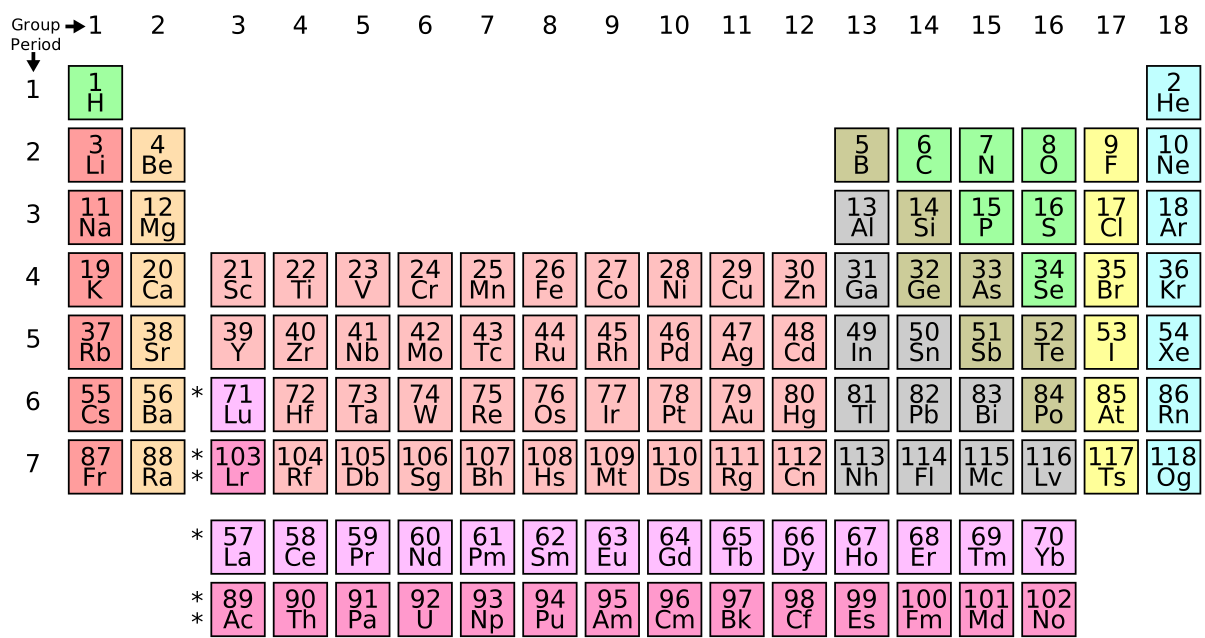
Then came the patterns. Johann Döbereiner noticed triads, three related elements whose middle member sits halfway between the other two: lithium, sodium and potassium; calcium, strontium and barium; chlorine, bromine and iodine. John Newlands saw properties repeat every eighth element and called it the law of octaves. In 1869 Dmitri Mendeleev arranged the elements so that the pattern held and, where it would not, left gaps. He predicted what would fill three of them, down to their weights and densities: eka-aluminium, eka-boron and eka-silicon. Gallium was found in 1875, scandium in 1879 and germanium in 1886, all within seventeen years.14 That predictive power is the curious part: a pattern that knew about elements no one had seen.
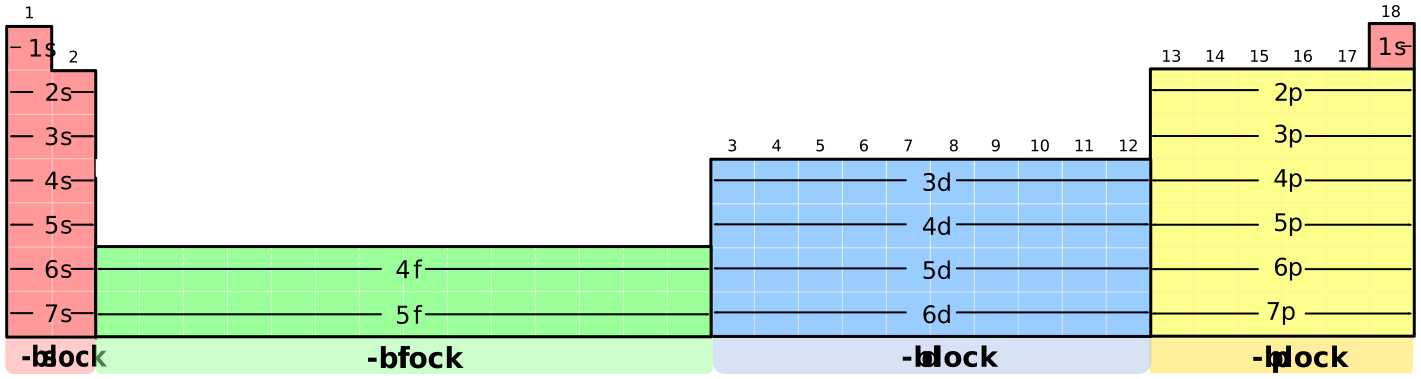
In 1913 Henry Moseley showed that the true order is atomic number, the charge of the nucleus, read from each element's X-ray spectrum.15 Quantum mechanics then explained the shape. An electron's orbitals come in sets of 1, 3, 5 and 7, the s, p, d and f subshells, and each orbital holds two electrons. That is why the blocks of the table are 2, 6, 10 and 14 columns wide, and why the rows run 2, 8, 8, 18, 18, 32 and 32 long. The sets of 1, 3, 5 and 7 are the ways a wave can sit on a sphere. The geometry of the table comes from the symmetry of a sphere.16
5. Where elements come from
The Big Bang made hydrogen and helium, and a trace of lithium, in its first few minutes.17 Stars fuse those into heavier nuclei, up to iron, where fusion stops paying.18 Most elements heavier than iron are built by neutron capture: slowly inside ageing giant stars, and in violent bursts when neutron stars merge. The second was confirmed in 2017, when a merger seen in gravitational waves was followed by the glow of freshly made heavy elements, a kilonova.19, 20 Lithium, beryllium and boron are the odd ones out: stars burn them rather than make them. Beryllium and boron, and part of the lithium, were chipped off heavier nuclei by cosmic rays striking gas between the stars.21 Every element can be traced to one or more of these sources.22
The fifth element has a modern echo too. Nineteenth-century physics needed a luminiferous aether for light to wave in. Michelson and Morley looked for the Earth's motion through it in 1887 and found none, and the aether was retired.23 Modern physics fills the same place with fields, and with a vacuum that is not empty: it carries a ground state of energy (the zero-point field of Lecture II). That is an echo worth naming as an analogy, not as a continuation.
6. Platonic shapes that really exist
Plato's solids recur in nature, though not as the elements he assigned them to. Methane is tetrahedral: four hydrogens at the corners of a tetrahedron around one carbon. Sulfur hexafluoride is octahedral. Boron builds itself from icosahedral clusters of twelve atoms.24 Many virus shells are icosahedral, because twenty identical triangular faces are the most economical way to close a shell from many copies of one protein.25 And common salt is cubic, sodium and chlorine alternating on a cubic lattice, one of the first structures ever solved by X-ray diffraction.26
7. Elements in consciousness (the practice half)
Each tradition above has a practice, one per mode. Buddhist body-element contemplation attends to the elements as qualities of sensation: hardness, cohesion, warmth, motion.6 Sāṃkhya maps them onto the senses, so attending to an element means attending through a sense.5 The Western hermetic tradition, Franz Bardon among others, works with them in imagination: feeling an element, gathering it in the body, and then balancing the four, so that no one quality dominates.27
A bridge to the body we can measure: fire as the warmth of the skin, air as breath, water as pulse and circulation, earth as weight and posture. Each is something a sitter can attend to, and each is something a sensor can read: a skin thermometer, the rhythm of the breath, the heart's beat-to-beat intervals, the stillness of the body. The claim about training stays experiential. What can be measured is the body's channels, and that is where Curious Life's instruments look.
The Elemental Qualities practice gives each element its own character on the screen and in sound, moved by the live reading; The Pulse reads the heart and the breath.
8. Honesty notes
- States of matter are an analogy, not a lineage. Earth as solid, water as liquid, air as gas and fire as plasma is a neat modern mapping, but no ancient author meant it, and most flames are only weakly ionised, so fire as plasma is loose.28
- Temperaments are prescientific. The humours were medicine's working theory for about two thousand years, and then turned out to be wrong.8
- Plato's assignments were wrong too. The regular solids do occur in nature, but fire is not made of tetrahedra.
- The practice claims are experiential. The traditions report what attending to the elements does; the measurable part is the body.
References
- Stanford Encyclopedia of Philosophy. Empedocles (the four roots, Love and Strife). plato.stanford.edu
- Stanford Encyclopedia of Philosophy. Philosophy of Chemistry, §1: Aristotle's chemistry, Lavoisier's elements, Mendeleev's periodic table. plato.stanford.edu
- Plato. Timaeus, trans. B. Jowett (the solids at 53c–57d). Project Gutenberg. gutenberg.org
- Stanford Encyclopedia of Philosophy. Plato's Timaeus. plato.stanford.edu
- Internet Encyclopedia of Philosophy. Sankhya (the gross elements and the senses). iep.utm.edu
- Buddhaghosa. The Path of Purification (Visuddhimagga), trans. Bhikkhu Ñāṇamoli, ch. XI: the defining of the four elements. Buddhist Publication Society. accesstoinsight.org
- Wang, Y., Bao, Q. & Guan, G. (2020). The Five Phases (wuxing). In History of Chinese Philosophy Through Its Key Terms, 211–220. Springer. doi.org/10.1007/978-981-15-2572-8_17
- Stelmack, R. M. & Stalikas, A. (1991). Galen and the humour theory of temperament. Personality and Individual Differences 12, 255–263. doi.org/10.1016/0191-8869(91)90111-N
- McCrae, R. R. & Costa, P. T. (1987). Validation of the five-factor model of personality across instruments and observers. Journal of Personality and Social Psychology 52, 81–90. doi.org/10.1037/0022-3514.52.1.81
- Newman, W. R. (2006). From alchemy to "chymistry". In The Cambridge History of Science, vol. 3: Early Modern Science, 497–517. Cambridge University Press. doi.org/10.1017/CHOL9780521572446.022
- Boyle, R. (1661). The Sceptical Chymist. Project Gutenberg. gutenberg.org
- Lavoisier, A. (1789). Elements of Chemistry, trans. R. Kerr (the table of simple substances). Project Gutenberg. gutenberg.org
- Dalton, J. (1808). A New System of Chemical Philosophy, part I. Internet Archive. archive.org
- Pulkkinen, K. (2019). The value of completeness: how Mendeleev used his periodic system to make predictions. Philosophy of Science 86, 1318–1329. doi.org/10.1086/705521
- Moseley, H. G. J. (1913). The high-frequency spectra of the elements. Philosophical Magazine 26, 1024–1034. doi.org/10.1080/14786441308635052
- Scerri, E. & Parsons, W. (2018). What elements belong in group 3 of the periodic table? In Mendeleev to Oganesson: A Multidisciplinary Perspective on the Periodic Table. Oxford University Press. doi.org/10.1093/oso/9780190668532.003.0010
- Cyburt, R. H., Fields, B. D., Olive, K. A. & Yeh, T.-H. (2016). Big bang nucleosynthesis: present status. Reviews of Modern Physics 88, 015004. doi.org/10.1103/RevModPhys.88.015004
- Burbidge, E. M., Burbidge, G. R., Fowler, W. A. & Hoyle, F. (1957). Synthesis of the elements in stars. Reviews of Modern Physics 29, 547–650. doi.org/10.1103/RevModPhys.29.547
- Abbott, B. P. et al. (2017). Multi-messenger observations of a binary neutron star merger. The Astrophysical Journal Letters 848, L12. doi.org/10.3847/2041-8213/aa91c9
- Kasen, D., Metzger, B., Barnes, J., Quataert, E. & Ramirez-Ruiz, E. (2017). Origin of the heavy elements in binary neutron-star mergers from a gravitational-wave event. Nature 551, 80–84. doi.org/10.1038/nature24453
- Reeves, H., Fowler, W. A. & Hoyle, F. (1970). Galactic cosmic ray origin of Li, Be and B in stars. Nature 226, 727–729. doi.org/10.1038/226727a0
- Johnson, J. A. (2019). Populating the periodic table: nucleosynthesis of the elements. Science 363, 474–478. doi.org/10.1126/science.aau9540
- Michelson, A. A. & Morley, E. W. (1887). On the relative motion of the Earth and the luminiferous ether. American Journal of Science 34, 333–345. doi.org/10.2475/ajs.s3-34.203.333
- Albert, B. & Hillebrecht, H. (2009). Boron: elementary challenge for experimenters and theoreticians. Angewandte Chemie International Edition 48, 8640–8668. doi.org/10.1002/anie.200903246
- Caspar, D. L. D. & Klug, A. (1962). Physical principles in the construction of regular viruses. Cold Spring Harbor Symposia on Quantitative Biology 27, 1–24. doi.org/10.1101/SQB.1962.027.001.005
- Bragg, W. L. (1913). The structure of some crystals as indicated by their diffraction of X-rays. Proceedings of the Royal Society A 89, 248–277. doi.org/10.1098/rspa.1913.0083
- Bardon, F. (1956). Initiation into Hermetics. (The elements in the body and the soul, their accumulation and balance.) openlibrary.org
- Fialkov, A. B. (1997). Investigations on ions in flames. Progress in Energy and Combustion Science 23, 399–528. doi.org/10.1016/S0360-1285(97)00016-6